
Program
The 90-Day Program
Group Therapy Daily
Individual therapy with a license therapist
Team Meetings With Partners for Progress
Graduation / Rehabilitation
Working With Therapists

Key Points
MENTAL HEALTH is critical for optimal living at every life stage and is always at risk of falling into illness if not cared for properly.
When mental illness strikes, the human desire to be close to others often fades away and the person who is struggling begins to withdraw from loved ones, isolating in ways that only heighten suffering.
Historically, it was commonplace for those struggling with mental illness to be segregated away from society; as far back as the 18th century, the first asylums were introduced and designed to house people with mental illness.
How Therapy Helps
Participants only need to be open and receptive to the idea of therapy (counseling) being offered to them.
There are differences between types of therapists (psychiatrists, psychiatric mental health nurses, psychologists, clinical social workers, licensed professional counselors, behavioral health counselors, marriage and family therapists, etc.).
Finding the right therapy and therapist for an individual participant is a two-way process: the therapist can decide whether a participant is appropriate for counseling and the participant can decide if the particular therapist is appropriate for him/her.
A suitable therapist should welcome a call from a participant for a minimum of five minutes in order to describe their approach before eventually scheduling a consultation meeting.
It is appropriate for a participant to ask a prospective therapist if he/she has done their own therapy around family of origin issues (CHILDHOOD TRAUMA).
Participants only need to be open and receptive to the idea of therapy being offered to them.
Group Sessions
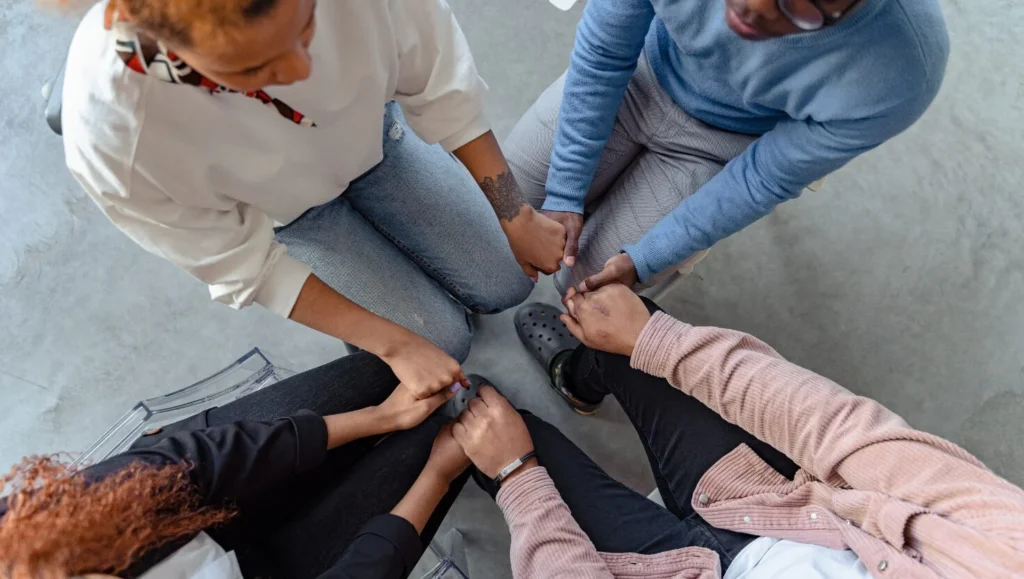
Structure of Group Sessions:
The group itself will be based on psychotherapy model with an emphasis on the role of emotions and childhood experiences in the lives of the individual participants.
There will be structured group exercises. These group exercises will correspond with the level of group development.
In the beginning stages of the group, exercises will primarily focus on the need for building a level of openness and trust among the participants.
In the later development of the group, the focus will turn more toward exercises that offer giving and receiving critical feedback to one another.
FROM EXPERIENCES group therapy (counseling) is a combination of self-help, as well as support, group that will serve as an adjunct to professional counseling.
Benefits
Participants of FROM EXPERIENCES group therapy (counseling) have common problems, can learn from one another and share in the goal of becoming the best version of themselves.
Participants who are open to feedback have, and participate in, the concept of FROM EXPERIENCES will benefit most from this shared experience with other participants.
The participants’ needs must match the goals of FROM EXPERIENCES group therapy (counseling).
The FROM EXPERIENCES team will monitor and study the dynamics of the group to make sure that the group and its participants are meeting their goals.
“We-ness”: Participants will be able to model the helpful behaviors of other participants.
Important Notes
Safe House
Cognitive Behavioral Therapies have cast a dark shadow in the prison system, where these approaches toward rehabilitation enshrine the thinking function of the brain over and above everything else. These conventional cognitive approaches are only helpful in a very limited way; this perspective mainly focuses on the present while men and women are still in prison and attempts to have them take the same thinking skills learned inside prison with them in their life outside of prison. These therapies spurn the notion that an examination of the past life of men and women before entering prison can have any redeemable value when it comes to changing their behavior, but also their thinking. The problem with mental illness and thinking is that people have trouble recognizing that their thoughts are themselves irrational, which in turn is exhibited in their irrational behavior. Many formerly incarcerated men and women find themselves locked in a never ending loop of negative thoughts that eventually manifest into a downward spiral.
A Place of Empowerment and Healing
With this in mind, FROM EXPERIENCES is a place to find a sense of empowerment, community and healing. FROM EXPERIENCES will serve as a liaison between its participants and the community, provide an educational program designed to empower both men and women and teach them coping skills needed to become productive members in society. In order to achieve the latter, FROM EXPERIENCES begins looking at a participant’s past, their childhood, with the recognition that in order to know where you are going in the future there has to be an understanding of experiences and trauma from the former. The goal is to aid participants in mending the damage that they experienced while in the “care” of authority figures and help them to identify and work on the dimensions of their CHILDHOOD TRAUMA and ARRESTED DEVELOPMENT.
Trauma, Relationships and Mental Health
The message about trauma, relationships and mental health that is found throughout the FROM EXPERIENCES curriculum is difficult for most people to conceptualize. However, the curriculum is designed to reawaken and nurture the human instinct to care for and protect oneself through thick and thin (i.e., Self-Preservation). With the guidance of a skilled and trauma informed team, this damage and developmental delay can be remediated. Participants will themselves learn the skills of seeing with the eyes of another, hearing with the ears of another, and feeling with the heart of another: Empathy. Healing can be very special when done in community, with the understanding that no two people find healing in the exact same way and that the paths towards healing are equally as diverse.
Repairing Relationships
FROM EXPERIENCES looks to repair the traumatized relationships that participants may have with themselves, by providing a safe place where they will learn how to love, protect and care for themselves in ways that do not become learned habits of self-contempt and abandonment. Research has shown a direct correlation between the size and strength of a person’s support system and that person’s likelihood to succeed in community. The same can be said for the effect that having a support system has on recidivism. Community is important, if not more important, than the therapeutic alliance between therapist and client. For example, if you can get a person struggling with ADDICTION plugged into a healthy community, then half the battle will be won. In fact, community can be a preventive measure for a myriad of mental illness much like a vaccine given to inoculate. In fact, if you want to take a step towards community healing, it is important to take an action that focuses on collective rehabilitation at a local level first which is the work of FROM EXPERIENCES, before considering how to extend it to reach out with more global.
Sharing and Receiving Without Judgement
FROM EXPERIENCES is all about sharing and receiving feedback without judgement, so a participant can respond effectively, learn from it, and move forward. FROM EXPERIENCES will make referrals and provide recommendations to their participants, as they work hand in concert with participants to choose the right therapist and the type of therapy personalized to meet the needs of the individual participant in the program.
Safe House Commitments:
FROM EXPERIENCES Safe House is committed to:
- Practicing therapeutic confidentiality
- Building safety and trust
- Refraining from criticism and unsolicited advice
- Forming co-counseling relationships
- Being a self-help support group
- Eliminating the fear of getting help from others
FROM EXPERIENCES Daily Schedule
Monday To Friday
- 8:00 am —- 9:00 am…..Breakfast Meal
- 9:00 am —- 10:30 am….Group Class/Session
- 10:30 am —-12:00 pm….Personal Time/Unwinding
- 12:00 pm —- 1:00 pm…..Lunchtime Meal
- 1:00 pm —– 2:30 pm…..Group Class/Session
- 2:30 pm —— 4:30 pm…..Coping Skills/ Application
- 4:30 pm —– 5:30 pm…..Dinner Meal
Weekend Saturday Schedule
- 8:00 am —– 9:00 am……Breakfast Meal
- 9:00 am —–11:00 pm…..Book Club
- 11:00 am—-12:00 pm…..Open Discussion
- 12:00 pm —-1:00 pm……Lunchtime Meal
- 1:00 pm —- 4:30 pm…….Weekly Review/Introspection/Reflections
- 4:30 pm —–5:30 pm…….Evening Meal
Weekend Sunday Schedule
- 8:00 am —- 11:00 am…..Personal Time
- 11:00 am — 12:00 pm….Brunch Meal
- 12:00 pm —- 4:30 pm…..Personal Time
- 4:30 pm —– 5:30 pm……Dinner Meal
The Curriculum (12 Modules)
- Childhood Trauma
- Arrested Development
- Depression
- Anxiety
- Post-Traumatic Stress
- Anger Management
- Substance Use & Addiction
- Emotional Intelligence
- Accountability
- Self-Destructive Behaviors
- Healthy Relationships
- Breaking the Cycle
Why This Program Matters
FROM EXPERIENCES seeks ‘voluntary participants’ who are themselves seeking to make the necessary changes in their life to become better versions of themselves. FROM EXPERIENCES foresees some participants being required by the court, probation and/or parole to attend mandatory treatment and FROM EXPERIENCES group therapy (counseling) fulfilling this requirement. This will be reviewed on an individual basis in order to fulfill the purpose of FROM EXPERIENCES and the motivation of the person for wanting to participate in the program is to be honored. The program will be ideal when it comes to be an ALTERNATIVE TO REVOCATION (ATR) and to prevent recidivism.